We built a Tinder-like UI to force decisions.
Users swiped. Nothing changed at work.
The dashboard problem
Part one ended with a surprise: external users wanted the dense version, not the clean one. That validated the concept. It also handed us a harder problem.
The Market Intelligence Dashboard felt complete — eight signal categories, a competitor breakdown, a Weekly Index Score that moved week to week.
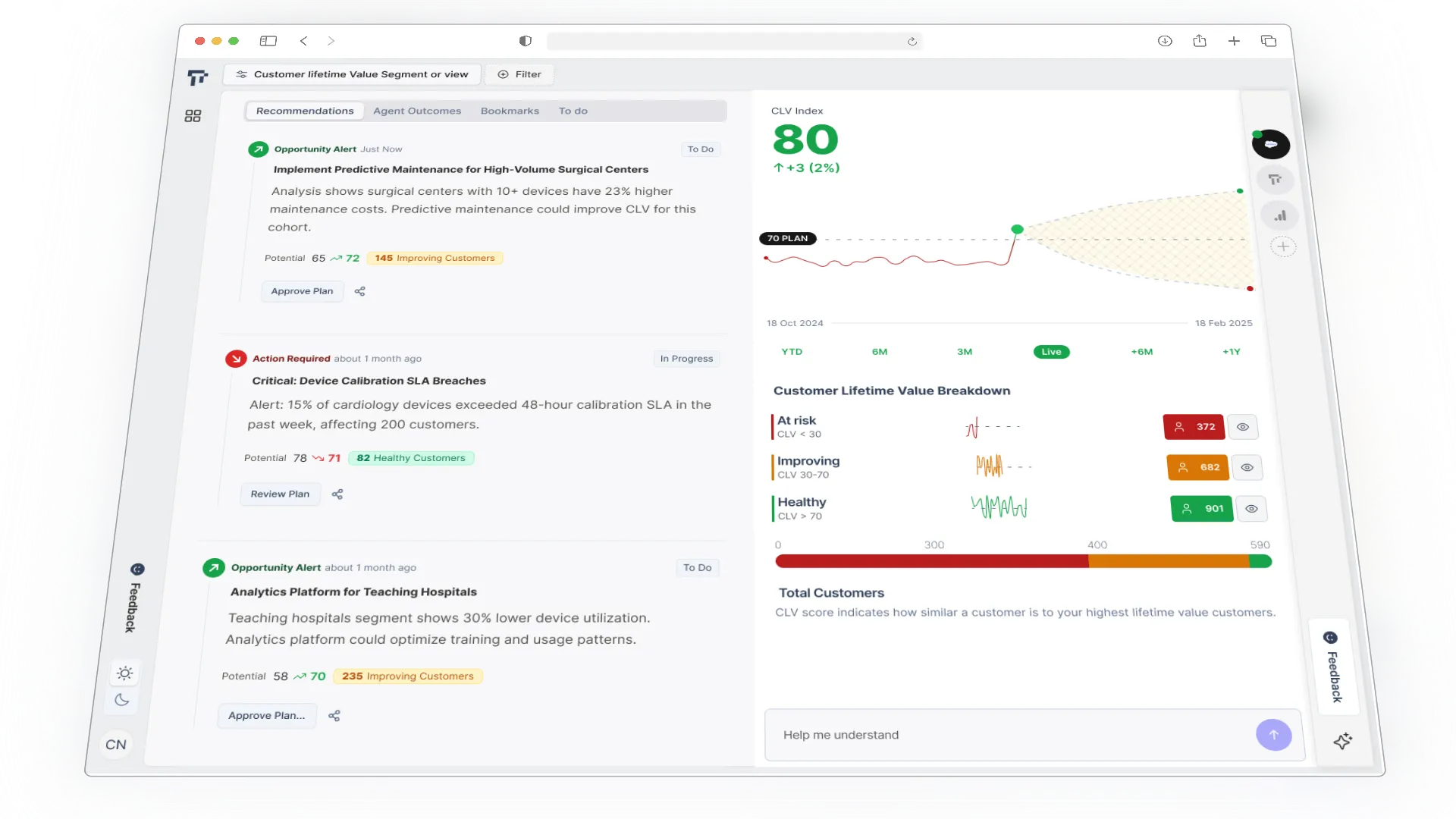
Users would spend twenty minutes in it and leave with a lot of understanding and no next action.
The Tinder hypothesis
Shrink the decision space. One insight at a time. A card. A binary prompt: act or skip.
The theory was sound. Reduce the degrees of freedom. People decide when the choice is binary.
What actually happened
The gesture worked. The interaction was clear.
Users moved through five, six, eight cards, then closed the tab.
It took a few follow-ups to understand why. The signals were accurate. Users couldn’t connect them to anything they owned.
Your competitor is gaining ground on feature adoption messaging — okay. What does that mean for my renewal? My pipeline call next Tuesday? The report I owe my VP?
The card couldn’t answer. We hadn’t given the product any way to know what the user was actually measured on.
The algorithm we weren’t talking about
Under the hood, the Weekly Index Score came from mapping positioning against a Jobs-to-be-Done framework — competitor content, reviews, and signals analyzed through JTBD job categories.
We deliberately didn’t surface this. We didn’t want users to need to understand JTBD to use the product.
But users knew the score moved. They didn’t know what made it move. Without that, they couldn’t decide whether acting on it was the right call.
What this pointed at
The swipe wasn’t the problem. The scoring wasn’t the problem.
The product had no view into the user’s business. It could tell you what the market thought. It couldn’t tell you what that was worth — in terms the user actually tracked.
That gap had a name: the CRM integration we’d been planning since day one, and deferring since day one.
Try the prototype
This is part two of a four-part series on building the Customer Value Agent at Thought Industries. Part three: The Integration We Couldn’t Build (And the One We Already Had).