
The product didn’t fail.
We aimed at the wrong people, and by the time we noticed, there wasn’t enough runway left to correct. That’s a different kind of problem — and in some ways a harder one, because it’s not a story about something breaking. It’s a story about something that was almost right going in the wrong direction.
This is part four of a four-part series on the Customer Value Agent — a funded bet Thought Industries placed on a new market, where I owned the product design and system architecture. If you’re landing here first, start from part one.
What I Owned
I didn’t own the production front end or the implementation. What I owned was the architecture — how the system should actually work: what signals fed the Weekly Customer Value Score, where the human stayed in the loop, how an insight became a draft, and how that draft moved out to the tools a team already used.
And I didn’t hand off a spec and hope. Using Subframe and Claude, I vibe-coded my way to a working version — enough of the real thing to click through and feel, not just describe. A prototype you can actually use surfaces the decisions a static wireframe hides: where the score needs competitive context, where activation has to be an explicit human call, what’s missing between an insight and a publishable draft.
That architecture work came to a head at a team offsite where we redesigned the entire app from the ground up — the wireframes from that session are where most of what you see above took shape.
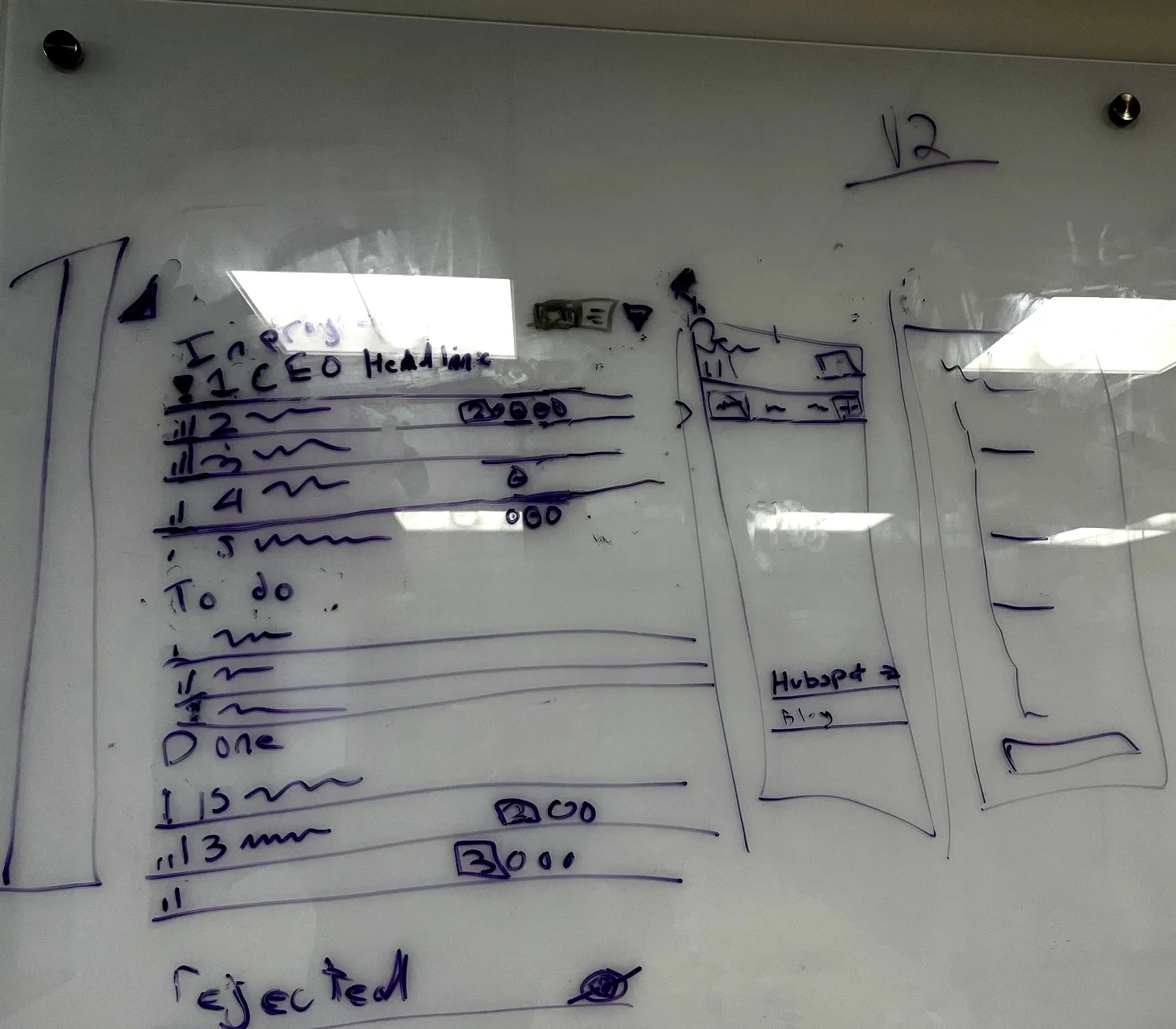
The call I’m proudest of was an architecture one: the Weekly Score could be computed from what the LMS already emitted. We’d written CRM integration into the plan as a hard requirement before I understood that the external data was a story we’d talked ourselves into, not a dependency.
What the Final Interface Looked Like
By the time we hit the approved prototype, the product had settled into something I was genuinely proud of.
The dashboard was clean. The Weekly Index Score had a clear visual treatment — week-over-week trend, a brief contextual explanation, and a direct connection to the LMS data driving the movement. The content generation feature had matured: one click from an insight to a draft article or guide aimed at closing the gap the market signal had identified.
The four customers using it were getting real, weekly signal they weren’t getting anywhere else.
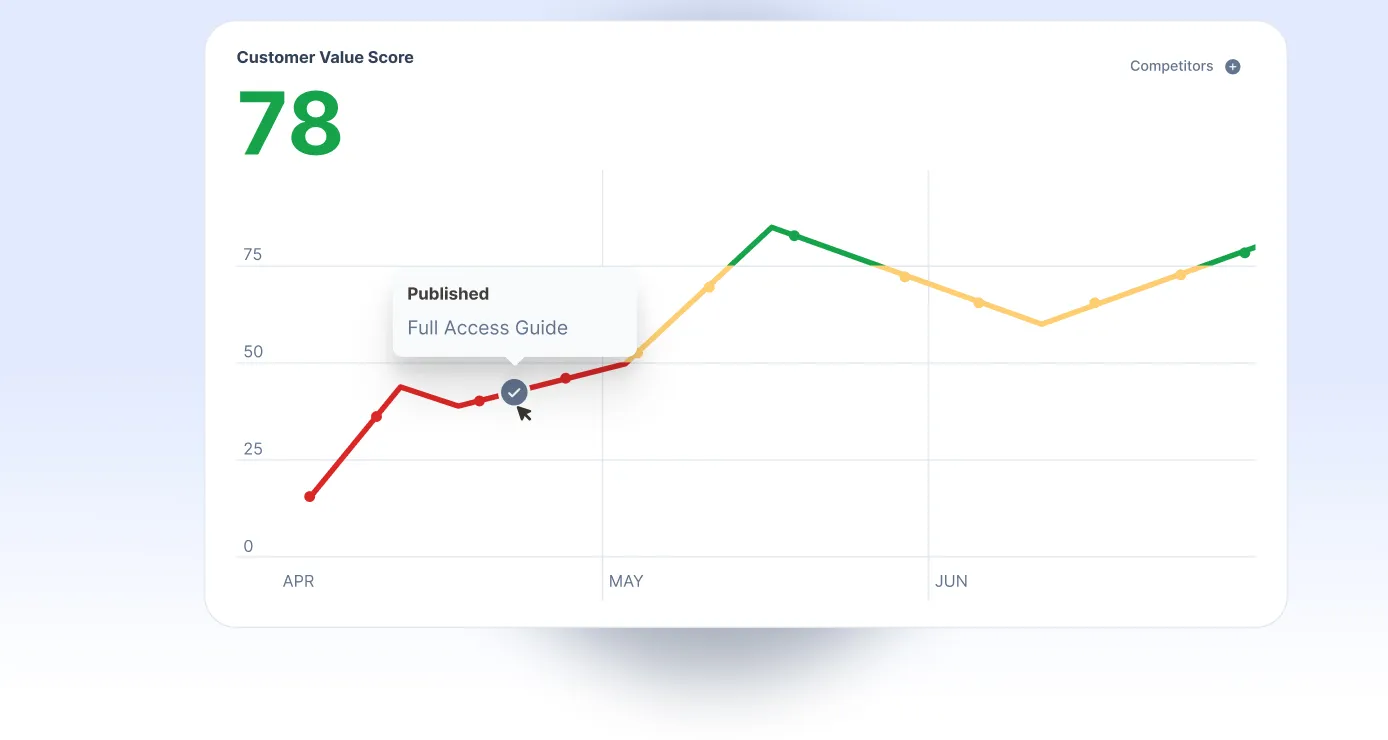
The Customer Problem We Were Creating
The strategic bet from the beginning was on a new ICP: customer education leaders at companies that run external learning programs. Not existing Thought Industries customers. New buyers.
The problem was execution. Chasing new buyers takes attention. Attention that wasn’t going to the customers already on the platform.
Existing customers felt it. The product roadmap had tilted. The narrative inside the company had shifted toward “what this product could become” rather than “what our customers need today.”
At the same time, the new customers we were trying to attract weren’t getting enough value to convert from beta to paid at the scale we expected. We were between two markets. Neither group was winning.
Four Was Not Enough
We had four paying beta customers. The plan had assumed more.
The gap between what leadership expected and what the market showed interest in was a signal nobody acted on quickly enough. In retrospect, the right move at the two-customer mark was a genuine reassessment: is the market there? Are we solving the right problem for the right people?
Instead, we kept building. The assumption held longer than the evidence supported.
The Wind-Down
A new CEO joined at the end of Q3 2025.
Within her first weeks, the strategic direction was clear: Thought Industries was going to become an agentic LMS platform. AI capabilities native to the learning experience, not layered on top. A different kind of product, built for the customers already on the platform.
When it came time to ask beta customers to move from beta to paid, the numbers weren’t there. The interest wasn’t there. The Customer Value Agent program ended.
What’s Being Built Now
The idea isn’t dead. It’s being absorbed into something with a larger foundation.
Through Q1 and Q2 of 2026, the team has been building the infrastructure for an agentic LMS. By Q3/Q4, that should start to become visible in the product. The logic behind the Customer Value Agent — using outside signals to inform what a learner or customer education program should do next — is a thread that could find its way into that architecture.
I’m still part of that work.
What I’d Do Differently
Stay closer to the customers who were already paying before chasing the ones we wanted.
Prove the ROI loop with LMS data before making CRM integration a requirement. We had access to the data we needed early on; we just convinced ourselves we needed external data to tell the real story.
Don’t mistake “tested well in research” for “will pay for this at scale.” Research tells you whether the idea is coherent. It doesn’t tell you whether the market is big enough, whether the price is right, or whether buyers will prioritize it against everything else competing for their budget.
The Answer to the Question I Asked in Part One
At the start of this series, I wrote about a question the wireframe research planted: can you design a system whose most important decisions are invisible to the people using it?
Here’s what I actually learned.
Invisibility alone isn’t enough.
The JTBD algorithm was invisible. The score it generated was real. But neither was connected to anything the user already measured in their working life — not until we made the LMS pivot, and by then the clock was running out.
When the most important decisions are invisible, the user needs to feel the output, not just see it. They need to be able to say “this changed something I own” — a number, a behavior, a result. Without that connection, invisible just means opaque.
That’s the thing I’ll carry forward: AI systems that hide their reasoning need to surface their impact. Not the algorithm. The consequence.
The Title Still Holds
This series is part of the evidence for why I now call myself a Design Engineer rather than a UX designer.
The Customer Value Agent didn’t ship at scale. But working on it meant getting into the codebase to understand what the LMS was emitting at the data layer, making design decisions informed by real API constraints, and proving the system with working prototypes — vibe-coded in Subframe and Claude — rather than handing off a spec and hoping.
That’s not what a UX designer does. It’s what I do.
The title holds. The project just also taught me that being the person who can build it doesn’t automatically mean you’re building the right thing for the right market.
Both things are true.